
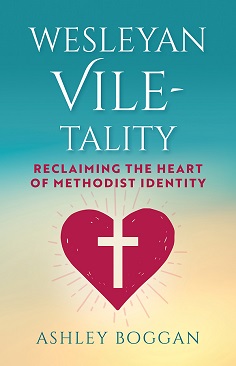
Wesleyan Vile-tality

Why Wesleyan Vile-tality?
This is the core aspect of our identity, one that we’ve lost, and one that we need to claim. It can be summed up in the ideology of Wesleyan vile-tality—a willingness to look beyond today’s acceptable practices, standards, and norms and bend the rules in order to ensure that more and more people can be included within the Kin-dom of God.
The UMC experienced its own grief and identity crisis. And now it’s time that we be reminded of who we really were, are, and could be again for in death, there is life. We have a chance to be reborn, to resurrect our true selves, to tell our stories anew. I hope that the stories throughout this book help us collectively move on and reclaim our identity and lead us towards a Pentecost, one that might signal a rebirth of The United Methodist Church as a connection that has, once again, found its willingness to be a bit more vile.
Despite being a bit lost in his call and down and out after being pelted, John just kept preaching, preaching, preaching. And it worked. We need love in this world. We need hope. But we also need a radical love that is willing to proclaim into all spaces, no matter the consequences, that God loves all and all are worthy of this love. We need radical hope to know that we can do this work because God is with us. Let’s do the thing that we aren’t supposed to do and psychologize John Wesley.
John stepped atop his father’s grave and preached his message of unconditional love, of human agency in holiness, and of walking hand in hand in the love of God despite difference. Again, he broke the rules and pushed the boundaries of society to share God’s love. Vile, indeed. I’ve chosen to not focus on the preaching laymen here and instead uplift the experiences and ministries of the laywomen who spoke, exhorted, led, and preached, despite being deemed “vile” for so doing. It is through their ministries that we can see most distinctly how the vile spirit was not limited to Wesley alone. Vile, indeed.
What happened to this vile spirit?
How could Methodists, those who believed in God’s love and worthiness of all people, in the ability of all people to seek the path of sanctification, of holiness, of pure love, how could they defend slavery? In this way, Methodist women collectively carried the spirit of vile-tality in their ministries, but their having to do this in unofficial, unordained, unlicensed means is exemplary of the loss of vile-tality by the institution itself. Even with ordination rights, sexism persisted, with women being sidelined from leadership positions and facing significant barriers to advancement within the church.
For the first time in our history as a connection, since 1784, we are not excluding anyone from any rank or status or access to the ministries of the church!
Amazing! Imagine the possibilities that lay before us without these restrictions. We can finally live into the practice that Wesley called us to, one of a “peaceful, joyous love of God, and an “inward witness that we [all] are the children of God.” And in practice, we could be new. Yes, the world has changed a lot since John Wesley lived, but it is still possible to reclaim the essence of what he did and stood for. And in all honesty, it shouldn’t be hard.
.jpg)

Michael Adam Beck
This book is a powerful, compelling narrative that brings the radical heart of John Wesley’s ministry into focus. It takes us beyond the comfortable confines of established faith practices and challenges us to step into the gritty, messy spaces where the Spirit is moving. With deep insight and vivid storytelling, my friend Ashley Boggan helps us reimagine what it means to be a Wesleyan today: a people who boldly love, serve, and share hope in places where others might hesitate to go.

Bishop Delores J. Williamston
Wesleyan Vile-tality: Reclaiming the Heart of Methodist Identity offers a brilliant exploration of the historical narratives of the Wesleyan movement. The book calls United Methodist to reconnect to their roots, engage in communal study, and move forward with renewed vile-tality, purpose, and hope. A must-read for anyone seeking to understand and strengthen the future of The United Methodist Church.

Bishop Kristin G. Stoneking
Ashley Boggan leads The United Methodist Church into clearly articulating who we are and what we stand for by pointing us toward our roots. In submitting to be more vile, Wesley proclaimed the fundamental tenet of Methodism: no one is outside the love and grace of God. Boggan offers us two visions: a church constrained by a version of vitality that trades respectability for faithful risk-taking or a church alive with vile-tality, standing in solidarity and humility with all.

About the Author

.jpg)